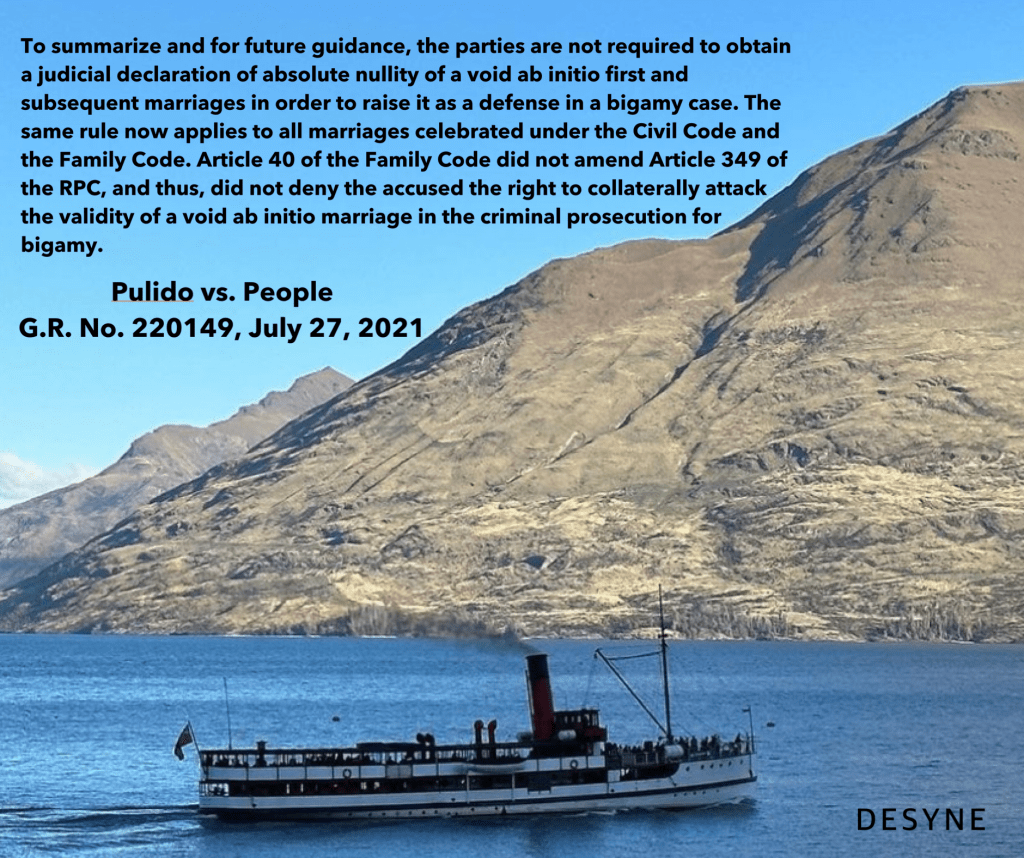
Void First Marriage is a Defense in Bigamy
Your trusted Law Firm in Iloilo City

Pursuant to Rule 9, Sec. 1 of the Bureau of Immigration Omnibus Rules of Procedure of 2015 (MC 2015-010), summary deportation proceedings shall apply in the following cases:

On November 14, 2016, Berto was engaged him as ordinary seaman by Colombia Shipping. His employment was covered by a Philippine Overseas Employment Administration (POEA) approved contract and PHIL Model LNG 2016 Collective Bargaining Agreement (CBA).
On December 5, 2016, Berto left the country for Cartagena, Colombia where he would board the freighter “Escobar” . Upon his arrival, Berto billeted him at the Columbiana Hotel while awaiting embarkation on December 7, 2016.
Unfortunately, on the day of his embarkation, Berto slipped while taking a shower at the Columbiana Hotel and fell on his buttocks. He felt excruciating pain and recurring numbness in his lower back and extremity. The incident, however, did not hinder him from boarding the vessel. Upon embarkation, Berto reported the accident to Pablo, one of the ship’s officer and requested for pain reliever. The latter relayed the incident to the chief mate. Instead of compassionately acting on his request, Berto was ordered to immediately go to work. He was made to carry heavy baggage and cans of grease the whole day.
Due to the strenuous work on the first day and lack of medical attention, Berto’s back pain worsened and he had difficulty getting out of bed the next day. Thus, he was sent to a hospital in Cartagena, Colombia where he was diagnosed with mechanical lumbago. Later, Berto’s worsening back pain led to his repatriation and when he arrived in Manila, was diagnosed to be suffering from disk desiccation and mild posterior disk bulge. In his Medical Evaluation Report, an independent physician assessed Berto to be suffering from total and permanent disability and declared him unfit for sea duty in whatever capacity. When Berto demanded disability benefits under the CBA in view of his untreated medical condition, the shipping company declined stating that Berto’s bathroom injury is not work-related injury and non-compensable.
Is Berto’s Injury considered work-related and compensable injury?
The Supreme Court ruled that slipping in the bathroom floor is not an unforeseen injurious occurrence that could not be reasonably anticipated. For once a person enters the bathroom, he knows for a fact that the floor could get slippery and cause him bodily injuries. Too, there is no showing of any measures petitioner adopted to at least lessen or avoid the injury caused by a slippery floor. Thus what happened to Berto cannot be considered the incident as an “accident” within the contemplation of the POEA-SEC contract.
The Supreme Court nevertheless finds that Berto suffered compensable injury under Section 20(A) of the POEA-SEC. For an injury or disability to be compensable under this provision, two (2) elements must concur: (1) the injury or illness must be work-related; and (2) the work-related injury or illness must have existed during the term of the seafarer’s employment contract. For a disability claim to prosper, a seafarer only needs to show that his work and contracted illness have a reasonable linkage that must lead a rational mind to conclude that his occupation may have contributed or aggravated the disease.
For the first element, the POEA-SEC defines work-related injury as one “arising out of and in the course of employment.” Jurisprudence further teaches that compensable illness or injury cannot be confined to the strict interpretation. of the POEA-SEC as pre-existing conditions may be compensable if aggravated by the seafarer’s work.
Here, it is undisputed that before actual boarding of the vessel on December 7, 2016, Berto slipped in the bathroom of Colombiana Hotel and suffered injury. To reiterate, this, by itself, is not compensable. But when Berto boarded his assigned vessel, he immediately reported the incident to the Pablo, the ship’s officer, as well as the excruciating pain and recurring numbness he had been experiencing on his lower back and extremity after said incident. Apparently, he was already suffering from mechanical lumbago and perianal abscess at this point. He requested for pain reliever but was not given any. And instead of showing compassion, his superiors ordered him to immediately get to work, making him carry heavy baggage and cans of grease.
These circumstances show that the injury Berto suffered at the Colombiana Hotel which would have otherwise been not compensable was aggravated by his work on board the vessel. Indeed, due to the strenuous work on the first day and lack of medical attention, petitioner’s condition worsened, and he even had difficulty getting out of bed the next day. In view of the factual backdrop, the Supreme Court ruled that Berto’s injury was work-related or more specifically, work-aggravated. As for the second requisite of a compensable injury, suffice it to state that Pablo’s condition was aggravated by his work during the term of his employment contract.
(based on the Supreme Court decision in “Calera vs.Hoegh Fleet Services Philippines,”G.R. No. 250584, June 14, 2021″. Names were changed for purposes of this article.)

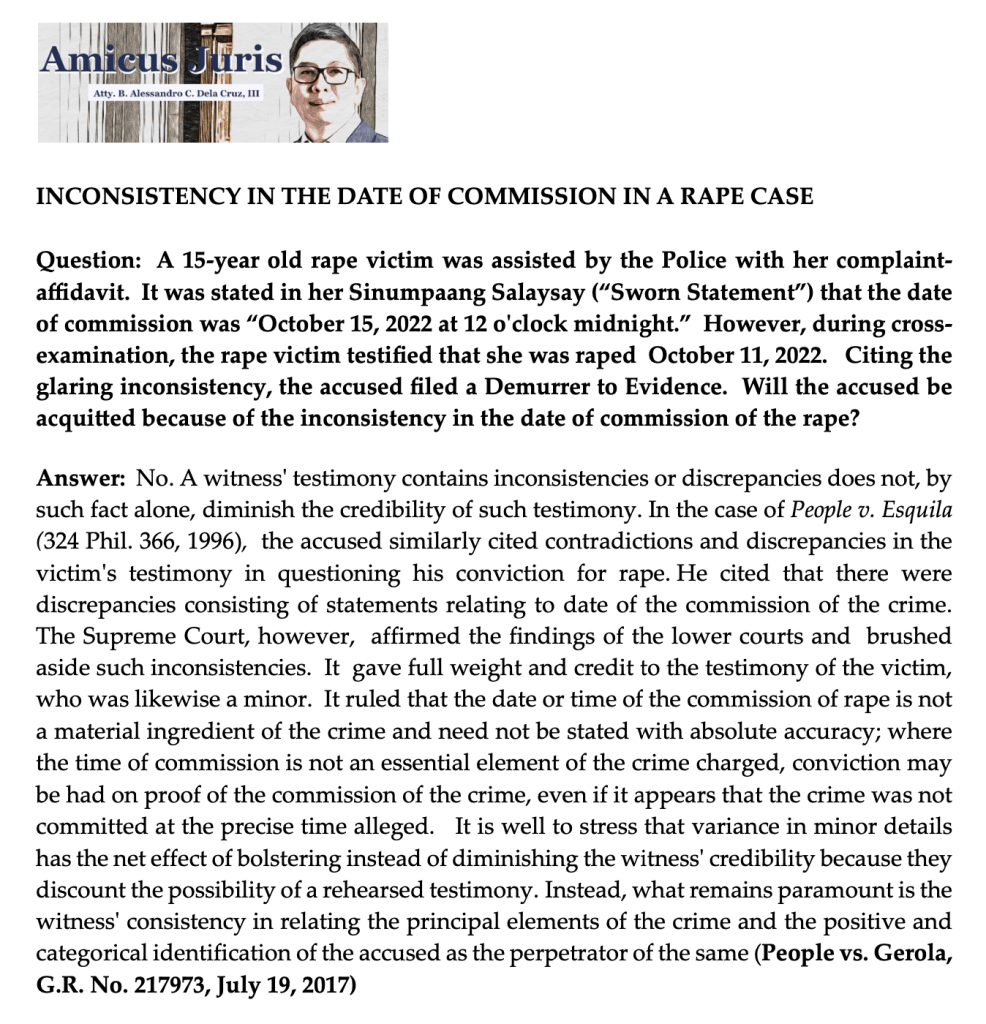
The crime of rape in the Philippines is a serious problem. The Philippine National Police (PNP) in a news report stated that rape is one of the most common crimes in the country with 3,762 cases from July 2021 to Jan. 7, 2022. Due to this alarming statistics, law practitioners should brush up on the latest legal jurisprudence on how to prosecute or defend in rape cases.
Denial
For decades, defense in rape cases is comprised by the impossibility of the accused to commit sexual aggression. Denial while considered a weak defense is the prevalent defense used by lawyers to prove that their accused could have not raped the private complainant. In the case of People vs. Astrologo (G.R. NO. 169873, June 8, 2007), the Supreme Court ruled that the defense of denial must be buttressed by strong evidence of non-culpability to merit credibility. This is because It is merely a negative and self-serving allegation that cannot be given any weight on the scale of justice. And although denial is a legitimate defense in rape cases, mere bare assertions to this effect cannot overcome the positive, straightforward, unequivocal and categorical testimony of the victim. It is an established rule that an affirmative testimony is far stronger than a negative testimony, especially so when it comes from a credible witness. Likewise, it is hornbook doctrine that such positive and categorical testimony of a rape victim, identifying the accused as the one who sexually attacked her, prevails over his bare denial.
Consent
Another defense frequently used is that the parties involved are actually in an amorous relationship (boyfriend-and-girlfriend defense). This defense is akin to “self-defense” as the accused no longer disputes sexual contact. In the case of People vs. Rapiz (G.R.No. 240662, September 16, 2020), the Supreme Court reiterated that it is the prosecution’s burden to prove beyond a reasonable doubt the elements of the crime of rape, which includes as above stated that an accused had carnal knowledge of a complainant through force or intimidation. Lack of consent through any of the modes mentioned in the RPC or case law as where moral ascendancy is involved is not to be presumed. However, where an accused alleges consent to the sexual act as a defense, it is his burden of evidence to prove this allegation by substantial evidence. Thus, consensual sexual congress as an affirmative defense needs convincing proof such as love notes, mementos, and credible witnesses attesting to the consensual romantic relationship between the offender and his supposed victim. Having admitted to carnal knowledge of the complainant, the burden shifts to the appellant to prove his defense by substantial evidence. Furthermore, even assuming arguendo, that there was some form of amorous relationship, such averment will not necessarily rule out the use of force or intimidation by appellant to have sex against her will.
It is however important to note that in rape of minors, defense of consent of the offended party is generally not valid.
Credibility of Offended Party is Dubious
In several Supreme Court decisions it is established that the credibility of the complainant is the single most important issue in the prosecution of rape cases. The categorical and candid testimony of the complainant suffices, and a culprit may be convicted solely on the basis of her testimony, provided that it hurdles the test of credibility. It should not just come from the mouth of a credible witness, it should likewise be credible and reasonable in itself, candid, straightforward and in accord with human experience. Where the discrepancies and contradictory statements on important details in the testimony seriously impair its probative value, cast serious doubt on its credibility, and erode the integrity of the testimony, the Court should acquit the accused (see People vs. Rapiz).
Marriage of the Parties
Article 266-C of Republic Act 8353, or the Anti-Rape Law of 1997 provides that subsequent valid marriage of the offended party shall extinguish the criminal action or the penalty imposed. Same article also provides that if it is the legal husband who is the offender, the subsequent forgiveness by the wife as the offended party shall extinguish the criminal action or the penalty. It should be noted, however, that for the crime of rape to be extinguished or the penalty be abated, the marriage is void ab initio.

In 2023, Travel+Leisure website has named Boracay Island in the Philippines as “10th out of 25 islands around the world for 2023” with a score of 92.94. This is due to the island’s innate beauty which never failed to captivate tourists from all over the world since it was discovered by European backers in the late 70s.
From a lay-back beach escapade to a vibrant tourism hub that attracts tourists from all over the world, Boracay island has become a magnet for real estate investors. There are now various real estate developments in the island which includes world-class hotels and resorts. There are also several condominium and townhouse units for those who want to make the island a regular holiday destination.

Whether it is the acquisition of hotels and resorts, condominium or apartment units, or commercial or residential lots, investors have to be reminded of the following considerations about buying real estate in the Philippines:
In addition, real estate investors should be aware of following issues that are peculiar to Boracay island:

It is also emphasized that under the Section 29 of Republic Act 9646 otherwise known as the “Real Estate Service Act of the Philippines” only licensed real estate brokers can practice or offer to practice real estate service in the Philippines or offer himself/herself as real estate service practitioner, or use the title, word, letter, figure or any sign tending to convey the impression that one is a real estate service practitioner, or advertise or indicate in any manner whatsoever that one is qualifed to practice the profession, or be appointed as real property appraiser or assessor.
For any legal information on buying real estate in Boracay island or any other areas in the Philippines, especially beach front properties, send us your legal inquiry via our e-mail attybaciii@gmail.com.

 Causing Dela Cruz Law Office