What is considered “Cruelty to Animals”?

“Cruelty to Animals” is defined under Philippine laws as follows:

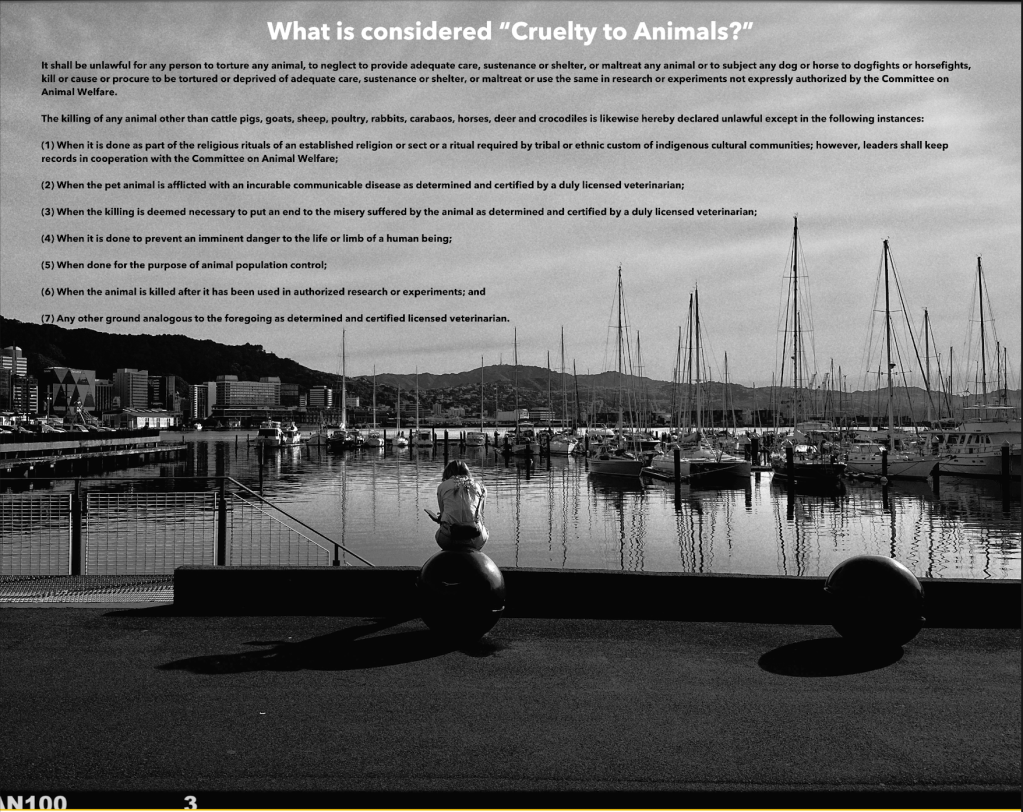
Section 6. It shall be unlawful for any person to torture any animal, to neglect to provide adequate care, sustenance or shelter, or maltreat any animal or to subject any dog or horse to dogfights or horsefights, kill or cause or procure to be tortured or deprived of adequate care, sustenance or shelter, or maltreat or use the same in research or experiments not expressly authorized by the Committee on Animal Welfare. 

The killing of any animal other than cattle pigs, goats, sheep, poultry, rabbits, carabaos, horses, deer and crocodiles is likewise hereby declared unlawful except in the following instances: 

(1) When it is done as part of the religious rituals of an established religion or sect or a ritual required by tribal or ethnic custom of indigenous cultural communities; however, leaders shall keep records in cooperation with the Committee on Animal Welfare; 

(2) When the pet animal is afflicted with an incurable communicable disease as determined and certified by a duly licensed veterinarian; 

(3) When the killing is deemed necessary to put an end to the misery suffered by the animal as determined and certified by a duly licensed veterinarian; 

(4) When it is done to prevent an imminent danger to the life or limb of a human being; 

(5) When done for the purpose of animal population control; 

(6) When the animal is killed after it has been used in authorized research or experiments; and 

(7) Any other ground analogous to the foregoing as determined and certified licensed veterinarian. 

In all the above mentioned cases, including those of cattle, pigs, goats, sheep, poultry, rabbits, carabaos, horses, deer and crocodiles the killing of the animals shall be done through humane procedures at all times. 

For this purpose, humane procedures shall mean the use of the most scientific methods available as may be determined and approved by the committee. 

Only those procedures approved by the Committee shall be used in the killing of animals. 

Section 7. It shall be the duty of every person to protect the natural habitat of the wildlife. The destruction of said habitat shall be considered as a form of cruelty to animals and its preservation is a way of protecting the animals. 

Section 8. Any person who violates any of the provisions of this Act shall, upon conviction by final judgment, be punished by imprisonment of not less than six (6) months nor more than two (2) years or a fine of not less than One thousand pesos (P1,000.00) nor more than Five thousand pesos (P5,000.00) or both at the discretion of the Court. If the violation is committed by a juridical person, the officer responsible therefor shall serve the imprisonment when imposed. If the violation is committed by an alien, he or she shall be immediately deported after service of sentence without any further proceedings. 

(Republic Act No. 8485  dated February 11, 1998 otherwise known as “A n Act to Promote Animal Welfare in the Philippines, otherwise known as “The Animal Welfare Act of 1998.”)

Causing Dela Cruz and Bernal Law Office is an Iloilo City-based law office with experience in animal protection policy making and advises people organizations on animal welfare.

How much is the local tax imposed on the sale, donation or any mode of transfer of real property?

For any inquiry about drafting of legal documents for the sale, donation or any mode of transfer of ownership of real property, BIR and Register of Deeds Processing, you can send us an email at attybaciii@gmail.com. You can also avail of free legal advice by going to the main menu.

Causing Dela Cruz Bernal Law Office has handled transfer of ownership of property via sale, donation and other modes of transfer of ownership. It is also well-experienced in computing applicable transfer taxes and charges and the application of Certificate Authorizing Registration (CAR) and issuance of new torrens title.

What to Watch Out when Buying Property in Boracay Island, Philippines

In 2023, Travel+Leisure website has named Boracay Island in the Philippines as “10th out of 25 islands around the world for 2023” with a score of 92.94. This is due to the island’s innate beauty which never failed to captivate tourists from all over the world since it was discovered by European backers in the late 70s.

From a lay-back beach escapade to a vibrant tourism hub that attracts tourists from all over the world, Boracay island has become a magnet for real estate investors. There are now various real estate developments in the island which includes world-class hotels and resorts. There are also several condominium and townhouse units for those who want to make the island a regular holiday destination. 

Whether it is the acquisition of hotels and resorts, condominium or apartment units, or commercial or residential lots, investors have to be reminded of the following considerations about buying real estate in the Philippines:

  1. Foreigners are prohibited from buying land. They can only invest in condominiums or apartments with separate title of ownership from the land.
  2. Former Filipinos are allowed to own land in exceptional cases. Filipinos with dual citizenship are allowed to own land as if they are Filipino citizens.
  3. Foreign corporations can own land by investing in a Filipino corporation up to 40% of its capital stock.
  4. Foreigners may acquire condominium units and shareholdings or membership in condominium corportions up to not more than 40% of the total and outstanding capital stock of a Filipino-owner or control corporation.
  5. Foreigners can lease condominium not exceeding a period of 50 years and renewable once for not more than 25 years.

In addition, real estate investors should be aware of following issues that are peculiar to Boracay island:

  1. Only properties covered by a Certificate of Alienable and Disposable (A&D) land classification and Certicate of Compliance with the 25+5 Beach Easement Ordinance are eligible for private ownership. 
  2. Road side properties should be compliant with road easement requirements.
  3. Most of the properties in Boracay island are covered only by tax declarations issued by the local government of Malay, Aklan. Real Estate investors and buyers should make sure that these properties are already issued and Certificate of A&D and are compliant with the beach and road easement regulations.

It is also emphasized that under the Section 29 of Republic Act 9646 otherwise known as the “Real Estate Service Act of the Philippines” only licensed real estate brokers can practice or offer to practice real estate service in the Philippines or offer himself/herself as real estate service practitioner, or use the title, word, letter, figure or any sign tending to convey the impression that one is a real estate service practitioner, or advertise or indicate in any manner whatsoever that one is qualifed to practice the profession, or be appointed as real property appraiser or assessor.

For any legal information on buying real estate in Boracay island or any other areas in the Philippines, especially beach front properties, send us your legal inquiry via our e-mail attybaciii@gmail.com.

Website Built with WordPress.com.

Up ↑