What is considered “Cruelty to Animals”?

“Cruelty to Animals” is defined under Philippine laws as follows:

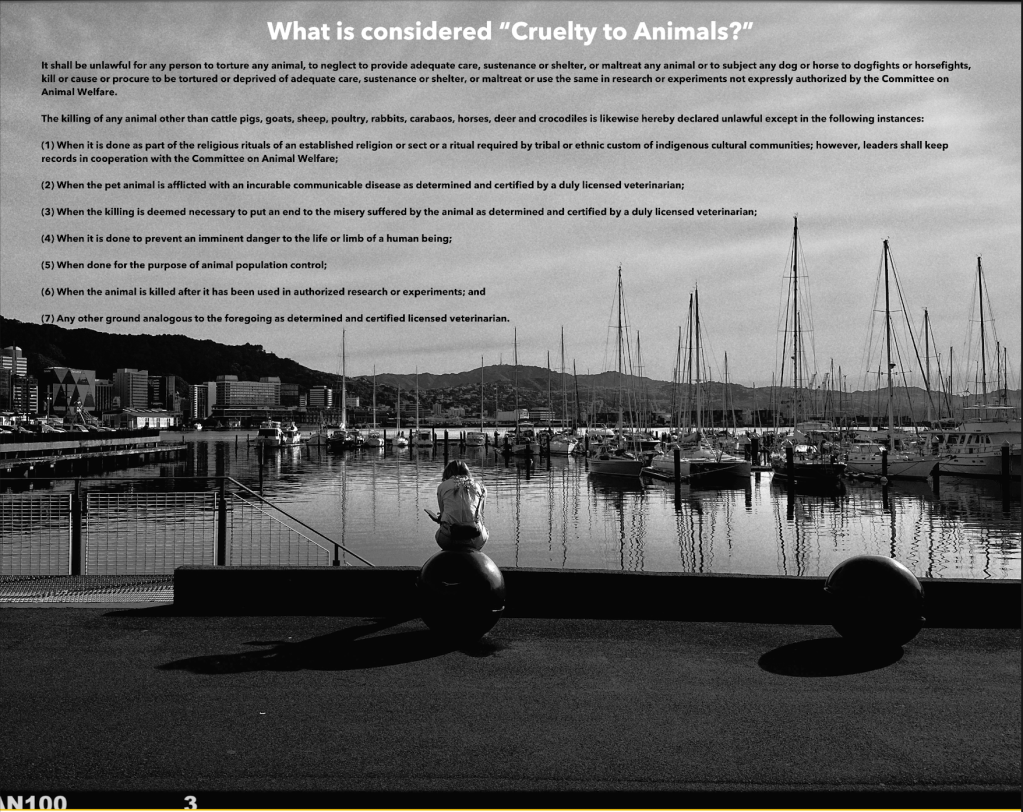
Section 6. It shall be unlawful for any person to torture any animal, to neglect to provide adequate care, sustenance or shelter, or maltreat any animal or to subject any dog or horse to dogfights or horsefights, kill or cause or procure to be tortured or deprived of adequate care, sustenance or shelter, or maltreat or use the same in research or experiments not expressly authorized by the Committee on Animal Welfare. 

The killing of any animal other than cattle pigs, goats, sheep, poultry, rabbits, carabaos, horses, deer and crocodiles is likewise hereby declared unlawful except in the following instances: 

(1) When it is done as part of the religious rituals of an established religion or sect or a ritual required by tribal or ethnic custom of indigenous cultural communities; however, leaders shall keep records in cooperation with the Committee on Animal Welfare; 

(2) When the pet animal is afflicted with an incurable communicable disease as determined and certified by a duly licensed veterinarian; 

(3) When the killing is deemed necessary to put an end to the misery suffered by the animal as determined and certified by a duly licensed veterinarian; 

(4) When it is done to prevent an imminent danger to the life or limb of a human being; 

(5) When done for the purpose of animal population control; 

(6) When the animal is killed after it has been used in authorized research or experiments; and 

(7) Any other ground analogous to the foregoing as determined and certified licensed veterinarian. 

In all the above mentioned cases, including those of cattle, pigs, goats, sheep, poultry, rabbits, carabaos, horses, deer and crocodiles the killing of the animals shall be done through humane procedures at all times. 

For this purpose, humane procedures shall mean the use of the most scientific methods available as may be determined and approved by the committee. 

Only those procedures approved by the Committee shall be used in the killing of animals. 

Section 7. It shall be the duty of every person to protect the natural habitat of the wildlife. The destruction of said habitat shall be considered as a form of cruelty to animals and its preservation is a way of protecting the animals. 

Section 8. Any person who violates any of the provisions of this Act shall, upon conviction by final judgment, be punished by imprisonment of not less than six (6) months nor more than two (2) years or a fine of not less than One thousand pesos (P1,000.00) nor more than Five thousand pesos (P5,000.00) or both at the discretion of the Court. If the violation is committed by a juridical person, the officer responsible therefor shall serve the imprisonment when imposed. If the violation is committed by an alien, he or she shall be immediately deported after service of sentence without any further proceedings. 

(Republic Act No. 8485  dated February 11, 1998 otherwise known as “A n Act to Promote Animal Welfare in the Philippines, otherwise known as “The Animal Welfare Act of 1998.”)

Causing Dela Cruz and Bernal Law Office is an Iloilo City-based law office with experience in animal protection policy making and advises people organizations on animal welfare.

Defenses in Rape Cases

The crime of rape in the Philippines is a serious problem. The Philippine National Police (PNP) in a news report stated that rape is one of the most common crimes in the country with 3,762 cases from July 2021 to Jan. 7, 2022. Due to this alarming statistics, law practitioners should brush up on the latest legal jurisprudence on how to prosecute or defend in rape cases.

Denial

For decades, defense in rape cases is comprised by the impossibility of the accused to commit sexual aggression. Denial while considered a weak defense is the prevalent defense used by lawyers to prove that their accused could have not raped the private complainant. In the case of People vs. Astrologo (G.R. NO. 169873, June 8, 2007), the Supreme Court ruled that the defense of denial must be buttressed by strong evidence of non-culpability to merit credibility. This is because It is merely a negative and self-serving allegation that cannot be given any weight on the scale of justice. And although denial is a legitimate defense in rape cases, mere bare assertions to this effect cannot overcome the positive, straightforward, unequivocal and categorical testimony of the victim. It is an established rule that an affirmative testimony is far stronger than a negative testimony, especially so when it comes from a credible witness.  Likewise, it is hornbook doctrine that such positive and categorical testimony of a rape victim, identifying the accused as the one who sexually attacked her, prevails over his bare denial.

Consent

Another defense frequently used is that the parties involved are actually in an amorous relationship (boyfriend-and-girlfriend defense). This defense is akin to “self-defense” as the accused no longer disputes sexual contact.  In the case of People vs. Rapiz (G.R.No. 240662, September 16, 2020), the Supreme Court reiterated that it is the prosecution’s burden to prove beyond a reasonable doubt the elements of the crime of rape, which includes as above stated that an accused  had   carnal   knowledge  of a  complainant  through   force  or intimidation. Lack of consent through any of the modes mentioned in the RPC or case law as where moral ascendancy is involved is not to be presumed. However, where an accused alleges consent to the sexual act as a defense, it is his burden of evidence to prove this allegation by substantial evidence. Thus, consensual sexual congress as an affirmative defense needs convincing proof such as love notes, mementos, and credible witnesses attesting to the consensual romantic relationship between the offender and his supposed victim. Having admitted to carnal knowledge of the complainant, the burden shifts to the appellant to prove his defense by substantial evidence.  Furthermore, even assuming arguendo, that there was some form of amorous relationship, such averment will not necessarily rule out the use of force or intimidation by appellant to have sex against her will.

It is however important to note that in rape of minors, defense of consent of the offended party is generally not valid.

Credibility of Offended Party is Dubious

In several Supreme Court decisions it is established that the credibility of the complainant is the single most important issue in the prosecution of rape cases. The categorical and candid testimony of the complainant suffices, and a culprit may be convicted solely on the basis of her testimony, provided that it hurdles the test of credibility. It should not just come from the mouth of a credible witness, it should likewise be credible and reasonable in itself, candid, straightforward and in accord with human experience. Where the discrepancies and contradictory statements on important details in the testimony seriously impair its probative value, cast serious doubt on its credibility, and erode the integrity of the testimony, the Court should acquit the accused (see People vs. Rapiz).

Marriage of the Parties

Article 266-C of Republic Act 8353, or the Anti-Rape Law of 1997 provides that subsequent valid marriage of the offended party shall extinguish the criminal action or the penalty imposed. Same article also provides that if it is the legal husband who is the offender, the subsequent forgiveness by the wife as the offended party shall extinguish the criminal action or the penalty. It should be noted, however, that for the crime of rape to be extinguished or the penalty be abated, the marriage is void ab initio.

Website Built with WordPress.com.

Up ↑